Showing posts with label China Mieville. Show all posts

Wednesday, May 04, 2011

Review: Embassytown by China Miéville

China Miéville is best known for his distinct version of weird fiction – be it the secondary world fiction of his Bas-lag novels or something nearer to our own as with The City and The City (Book Depository, Powell’s Books, Indiebound) and Kraken (Book Depository, Powell’s Books, Indiebound). In his newest novel, Embassytown (Book Depository, Powell’s Books, Indiebound), Miéville shows off his literary versatility with his first science fiction novel.

Embassytown is a galactic backwater colony located far off the beaten path at the dead end of a minor inter-stellar travel route. Its only importance is in the unique bio-engineered products produced by its one indigenous sentient species, known as Hosts. Avice is a human who was born and raised in Embassytown and is one of the few locals lucky enough to get out as an immerser, a sort of inter-stellar astronaut. But what really makes her unique is that she comes back, and it’s through her eyes that we see events unfold that change Embassytown forever.

Miéville is a master of creating atmosphere and all things weird, which is one of the most exciting aspects of his foray into science fiction. Embassytown is an isolated backwater and Miéville subtly reinforces this through the travels of Avice. The atmosphere he creates is superb – and it’s utterly alien, which is where the weird comes in.

All too often sentient science fictional races feel too anthropomorphized – either that or they feel like too strong of an effort to avoid anthropomorphization. Miéville walks this fine line with excellence and subversion. The Hosts and their world are completely alien, yet the mistake made over and over again is to assume that they can be understood in ‘human’ terms. While Miéville’s descriptions of the Hosts are strong, they are just vague enough that I don’t really have a good mental image of what a Host really looks like, and that feels just right. Unfortunately, it’s a bit tricky to write about the most fascinating and more subversive qualities about Miéville’s aliens without giving too much away, so I’ll leave that for readers to explore on their own.

But the real emphasis of the Host’s alien nature is in their language. It is unlike any other known language in the galaxy and humanity has had to do some really horrific genetic engineering to develop communication with the Hosts – communication that is in reality not well understood at all. Through a bizarre ritual Avice actually becomes a simile in the Host’s language – she is an object of the language, an object of reverence and true meaning. And it confuses the hell out of her. I know my description of this aspect of Embassytown feels incomplete and probably a bit confusing, but long essays could be written on this and my advice is to read the book to come to an understanding of your own.

Miéville is really a spectacular writer and stylist. Over the years his subtly has increased and his writing has become more accessible as a result. An example of a very effective part of this is found in the first few chapters of Embassytown. I hesitate to write about it because doing so can spoil the effect, but it’s not any more of a spoiler than you get from reading the jacket description. The first person point of view feels more correct that I think I’ve ever read before. And it’s androgynous in its portrayal – how often do your thoughts think of yourself in terms of gender? I naturally fell into the subconscious view that the narrator was male – I suppose that’s because I’m male. As a result it was a bit of a pleasant surprise when the narrator turned out to be female. In terms of the overall book, it’s subtle and perhaps not of great importance, but I found it refreshing and it fits in well with Miéville’s playing with gender roles.

There has been a bit of discussion on whether Embassytown is a (critical) response to The Sparrow by Mary Doria Russell (Book Depository, Powell’s Books, Indiebound), with Miéville hinting at it himself. I’ve not read the The Sparrow (it’s been languishing on the shelf for years), so I can’t comment too directly to it – but from what I’ve read about The Sparrow, it could be true. Miéville does touch on some aspects of gender roles and sexuality in Embassytown, but they are mostly secondary and rather subtly presented, so I don’t think that the response is in the gender aspects of The Sparrow. If Embassytown is a response to The Sparrow, I believe it’s in the capacity of presenting a very interesting take on the consequences of actions and the changing of an alien species, but limiting Embassytown to a response and not a legitimate and independent work in its own right is probably a mistake.

It’s through Embassytown’s view of colonialism that it becomes rather interesting, if not necessarily unique to the writings of science fiction. Embassytown is not told from the more traditional perspectives of colonists seeking independence, repressed indigenous species seeking freedom, or the conquering nation/empire/species – it is essentially the story of simple people trying to survive. And the ambiguity of where those simple people fall on that list of traditional perspectives is thought provoking – especially considering how the book ultimately ends. Is it a happy ending? Is it a sad ending? Was a culture destroyed or saved? Is it overall a hopeful story or one of despair? Who were the winners and losers? Were there winners and losers? Miéville doesn’t take any clear sides – he lays it out for readers to consider.

China Miéville makes a refreshing and welcome journey into science fiction with Embassytown. It combines his mastery of mood and setting and his sense of the weird and alien with his distinct style. The story and ideas aren’t necessarily original and it remains to be seen how true devotees of science fiction will react to a few of his ideas on interstellar travel and such, but Miéville certainly breaths a breath of fresh air into a science fiction market that is often perceived as stale and dying.

Thursday, December 16, 2010

Just How Do You Buy Books as a Gift for Someone?

Like many families, mine does a Christmas gift exchange where each of draws the name of another family member. This year I drew my cousin John. Now John is the youngest of our 13 cousins and even though he’s now in his upper-20s, I still know him as that little annoying kid of a cousin from podunk Oklahoma. Never mind that he’s grown into a man with multiple piercings, a genius IQ, and a college degree who’s spent the last few years hanging out in Japan. Since I haven’t really spent much time around him in over 10 years I don’t know John as an adult. So, just what kind of gift am I to give him?

My family is made up of a bunch of readers. Nearly all of us read a lot and many within the SFF genre (this is where I was first introduced to the Wheel of Time). So books are the obvious gift. But, what books? A gift card is certainly the easy way out – my time is limited and valuable and it sure is easy to allow John to pick out his own gift (and I get to avoid lines at the post office). While practical, a gift card is boring and unexciting, though it still remains my default mode. My wife suggested that I actually buy him a couple of actual books – what a novel idea.

After thinking on it, I became quite excited by the idea. After all, I’m a big important blogger, of course I know what books would make good gifts. But I really don’t know John well – he’s all growed up now. So, just what books would I get a single, highly intelligent young man who (hopefully) enjoys SFF fiction but very likely falls on the eclectic side?

I decided to stick with fantasy (it’s what I know best), but I went with books that tend to be non-traditional, intelligent (even literary), and a bit dark and serious while maintaining an entertaining feel. Or at least that’s what I started with. In the end, I picked these three:


Hard-Boiled Wonderland and the End of the World by Haruki Murakami (Book Depository, Powell’s Books, Indiebound)


I sure hope John likes them.


So, how do you think I did?

Wednesday, April 28, 2010

Review: Kraken by China Miéville

Kraken by China Miéville (Book Depository, Powell’s Books, Indiebound) is a bad joke. How can I say that about a book by the only 3-time Arthur C. Clarke Award-winning author (not to mention all the other awards he’s won)? Read the book – it is literally a bad joke. Of course, it’s also an excellent novel from an excellent writer – wonderfully dark and creative, what urban fantasy should be.

Billy is a curator at the Natural History Museum of London, a curator specializing in preserving mollusks, including the museum’s prize specimen, a giant squid. Impossibly, one day the squid and the tank that preserves it disappear. Slowly Billy finds himself immersed in an underworld of magical cult worship – he may be a prophet, but he’s also wanted by the most dangerous forces in London, and he just may be the key to ending an impending apocalypse.

First I must state just how far my geekiness goes – a few years ago I read The Search for the Giant Squid by
Richard Ellis (Book Depository, Powell’s Books, Indiebound) for fun and because I thought it would be cool (and it was) – probably the only nonfiction book I’ve read for pleasure in the last 15 years. So, to say that a fantasy book by an author like China Miéville about giant squid is a book I’m going to like is one hell of an understatement. And predictably, I loved Kraken.

Kraken is urban fantasy as it should be – dark, dangerous, and creative with both a modern and nostalgic feel, and lacking trite pop culture interpretations of mythological monsters covering up romance and wish fulfillment. Miéville slowly reveals the underbelly of magical London through religious and criminal fanatics, including a tattooed kingpin, squid-worshiping cult, rogue assassins, cults of all kinds and personalities, familiars on strike, and a duo of bad guys channeling the likes of Gaiman’s Croup and Vandemar, Bond’s Mr. Wint and Mr. Kidd , and even Pen & Teller. Miéville further peppers the text with homage to science fiction and fantasy books, film, and television and a wicked sense of dark humor largely lacking in his earlier works.

Kraken generally takes the form of an action-thriller with Billy and his allies frantically evading enemies while trying to avert the coming apocalypse, full of the usual action and plot-twists. Hell, it’s practically a classic ‘buddy movie’ complete with all the action, adventure, and sardonic one-liners (if a bit more clever than most). However, this is China Miéville and he simply can’t write without at least a bit of social context. Perhaps the most obvious is through Wati, a sort of magical union boss directing the familiars of London in a strike – this story line is complete with picket lines, strike breakers and a scab familiar squirrel. But more subtle a the discussion of religion and humanity. Religion, cultism, fanaticism, and the like all play a key role in Kraken and the inevitability of humans relying on such – perhaps not a condemnation, but a conversation bearing a mirror, a conversation occurring between the lines.

Kraken will likely prove to be the most buzzed/hyped SFF book of 2010 – how could it not, being a Miéville novel, anticipated for years, and coming at the heels of an unprecedented 3rd Arthur C. Clarke Award. I fear this will lead to the inevitable letdown even though this review will likely only add to the buzz. Kraken is a bit hard to get into – the style is dense and full of scientific, religious, psychological, and street language. It took me a while to adjust, and as a scientist, I was not challenged by the scientific lingo. I was also a bit annoyed by the ending, perhaps the one thing Miéville is regularly criticized about. Warning, the next couple of lines could be considered spoilers – there was an over-reliance on Darwin versus religion, it was a bit too cheeky with it’s ‘but it’s not over yet feel’ and while I like the openness, I fear for the push of a sequel. However, the overall strength of Kraken far outweighs its few weaknesses.

Kraken is the latest from the highly decorated China Miéville and a return to London. It’s a story of religious, cultist and criminal fanatics, it’s the story of a young man awakening to world around him, it’s a story of loss, it’s an apocalyptic, action-packed thriller, it’s magical, it’s squidpunk, it’s all a bad joke…and it’s simply an example of a master at work. Highly recommended. 8.5/10

Monday, April 10, 2006

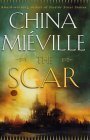
Review: The Scar by China Miéville

Miéville is one of most important voices in SF – period. His dark, gritty writing captures the reader, sucking them into his imagined world. The writing is intelligent and poignant, without becoming preachy – a fine line Miéville easily negotiates without being obvious to the reader.

The Scar takes places in Bas-Lag, Miéville’s fascinating and macabre world. The first novel set in Bas-Lag is Perdido Street Station, which is set in the massive, alien, yet familiar city of New Crobuzon. The Scar is set shortly after, yet we never see the streets of New Crobuzon. The Scar completely stands on its own, and is only tangentially related to Perdido Street Station. His third Bas-Lag novel, The Iron Council, returns to New Crobuzon some years later, and again stands alone.

The Scar follows Bellis, an intelligent and jaded women forced to flee New Crobuzon due to unfortunate coincidences and a military inquiry. On the journey to a distant colony, her ship is attacked and Bellis and the surviving passengers are forced to become citizens of Armada, a giant floating city of pirates. Fellow passenger Simon Fench has important knowledge that he must get to New Crobuzon, and he enlists Bellis to help. Bellis finds herself in the middle of the secret ambitions of the Armada and their plan to attain unequalled power.

Miéville’s world is a menagerie of personality and species. His world contains countless sentient beings, of which we see mosquito ‘people’, sentient cacti, sentient insects, aquatic species, vampires, and more. The setting is masterfully created, and not overdone in places as it was in Perdido Street Station. The Scar is the story of political ambition, the power of the people, manipulation, illusion, and of scars.

Miéville hits his stride in The Scar. The novel has almost none of the weaknesses of Perdido Street Station (not to imply that PSS is anything less than a superior novel and a classic). While the story is not quite as well constructed, it remains addictive. On my 10-point classification, where 5 is a take-it or leave-it novel and 10 is unsurpassed, The Scar ranks an 8 – Miéville is a must read for serious fans of the genre, and should be read outside of it.

Related Reviews: King Rat

Thursday, February 09, 2006

Review: King Rat by China Miéville

King Rat is Miéville's first novel. It is set in a late-90s London (not in fictional New Crobuzon like his other novels - Perdido Street Station, The Scar, and Iron Council). The imagery and language is dark and gritty, as I've come to expect from Miéville. The use of London street slang can be a bit difficult to understand for us 'Americans', but in the end context creates understanding and it adds to the atmosphere of the book. Right beside the coarse slang of the streets of London is the industrial music of late-90s, Jungle. Jungle plays a key role in the story and will especially appeal those familiar with the music and the Rave-type scene. Miéville is fantastic at creating the mood of a city through his descriptions. In King Rat I felt he gets it just right - in the other novel I've read by him (PSS) it seems a bit over done at times.


Upon returning to London, Saul is arrested and blamed for the death of a family member. Shortly after his arrest he is rescued from jail by a mysterious man calling himself King Rat. This man has inhuman strength and agility and smells of an animal - a very dirty and stinky animal. Saul has much to learn from King Rat - about himself and the world as he has never seen it.

In this new world, Saul learns of The Piper - the same Piper from the fairy tale that rids Hamlin of rats and ultimately its children. The Piper can play his tune to the entire world's species, he is in town, and he wants both Saul and King Rat dead.

The story is well told, if not as engrossing as Perdido Street Station. At times you can taste the world of Saul and King Rat - and you wish you couldn't. Overall it is a good read, though I hesitate to call it a great read. On a 10-scale, where 10 is unsurpassed and 5 is a take-it or leave-it book, I score King Rat at 6.5. In comparison, I'd probably score Perdido Street Station at 8.5 or even 9.

Related Reviews: The Scar

LinkWithin

Related Posts Plugin for WordPress, Blogger...