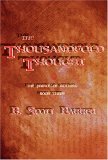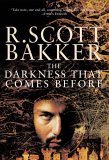
The Prince of Nothing Trilogy by R. Scott Bakker
The Prince of Nothing trilogy stands apart as the single best completed fantasy series that I have read to date. Many will cry foul – “How could you dismiss the Lord of the Rings, the holy trilogy?” And many others will cry – what about Erikson and Martin (or even, what about Jordan and Goodkind *shudders the thought of Goodkind*)? Of course the caveat is the word completed, but all semantics aside; this is a superb work of speculative fiction.
The players of the story are rather familiar – a doubting sorcerer, a great warrior from a warlike people, a trodden-upon woman, and a mysterious, all-powerful, and charismatic leader. The world and its people are also nothing strikingly new – a pre-industrial world with European overtones, pale people of the north, darker skinned of the south, clashes in the desert, religious intolerance and wars. The characters are real, the battles epic, the sorcery powerful; and the beauty is what Bakker does with these elements. He creates a compelling story, that while using familiar pieces, builds into something new, something better.

On the surface, the Prince of Nothing is the history of a vast holy war, a clash of cultures and religions, and the ominous anticipation of a greater conflict, a true apocalypse. However, Bakker uses these as vehicles to do much more than merely entertain with a gripping narrative; he challenges the reader about good, evil, perception, manipulation, culture, gender, equality, and religion.
The heart of the story is a holy war, a crusade, a jihad. The condemnation of religious fanaticism, and perhaps even religion itself, is clear – or is it. Religion is just another tool Bakker uses to show us the true object of his ire: certainty. When people become certain in their actions and beliefs, there is no room for anything, or anyone else. Absolute ideas and beliefs result in absolute decisions, reactions, and solutions. The ultimate result of such certainty is horror – absolute horror. Bakker shows us this lesson through his distinct brand of looking glass.
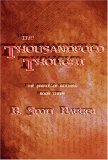
The weighty themes discussed above may serve to scare off many a reader – don’t let them. The powerful tale is not sacrificed for a message, but enhanced. Certainty is there, in your face, challenging the whole time; but it is not heavy handed. In the end, the message is clear, but never didactic, always an element of the story. The Prince of Nothing is a great work of epic fantasy, of speculative fiction, of literature. A must read for traditional genre fans, but it also will appeal to fans disenfranchised by the genre, and fans from outside of genre.
The conclusion of the trilogy brings us to a horrifically appropriate end, but does not yield ultimate closure. While some may be less than pleased by this, I revel in the knowledge of more to come. We’ve seen the Holy War, next is the Second Apocalypse – The Aspect Emperor, a planned duology. I’ve not rated a series before, but I think it appropriate to do so – on my 10-point scale, where 5 and below are not recommended, and 10 is simply unsurpassed, the Prince of Nothing gets a 9; they don’t get any higher than that.
Related reviews: The Darkness That Comes Before, The Warrior Prophet, and The Thousandfold Thought. Interview.