Showing posts with label John Scalzi. Show all posts

Friday, March 17, 2017

Review: The Collapsing Empire by John Scalzi

John Scalzi begins a new space opera with The Collapsing Empire which is sure to please fans of science fiction. In short it is fun, fast-paced and very accessible. Or…just the book I was needing to read when I read it.

The set-up is a 1000+ year old empire spanning multiple space systems that utilize a sort of parallel energy called the flow to travel between systems where standard travel would never be possible because of the true distance between stars. The empire has been intentionally designed to be interdependent, where no single system will have the ability to survive independently of the others. A few individuals learn that the flow that ‘connects’ systems is about to shift over a period of only a few years, fragmenting humanity into isolated worlds that are doomed to tragic ends.

Along the way we learn that the entire socioeconomic structure of the empire with its monopolistic guilds, strict societal class delineations, and dynastic rule is all just a con job to further enrich the powerful and keep the masses just content enough to not cause too much trouble. In an entrenched, bureaucratic society the will to actually meet an existential threat simply doesn’t exist, and often the will to even acknowledge the possibility that such a threat could be real is lacking.

The Collapsing Empire largely serves as an introduction to the empire, to the physics of Scalzi’s created universe, and to the characters who personalize the story. In this, there is a lot of exposition, but not so much that I was ever bothered by it. Scalzi writes with a brisk pace and a slight irreverence that sets a nicely balanced tone for the book (and presumably the rest of the series). Humor is a big part of it, but it’s more a sense of levity in the face of what’s to come that drives the story. The end result is that things feel more hopeful than anything, making the story fun to read, even in the face disastrous consequence for humanity. And through all the levity, Scalzi still manages to set the stage well for an empire that has stagnated or even regressed, where innovation and flexibility is stifled by tradition and economic interest in the status quo.

It is often said that Scazli writes some of the most accessible science fiction, and I certainly agree. Concepts are not that difficult for someone on the outside of the science fiction world to enjoy, yet they are thought through enough to satisfy (most of) those who are long-time fans. It’s full of high adventure and fun with consequences that matter to story.

For all of this to be successful, it comes down to the people of the story, and Scalzi excels in this. Three main characters are built up as the protagonists of The Collapsing Empire – the newly ascended Emperor, the scientist son of the researcher who discovered the impending collapse of the flow, and familial representative of one of the largest trade guilds. Or the inexperienced political outsider who unexpected ascends to the most powerful role in the galaxy, the naïve young scientist from a remote backwater, and hard-edged and exquisitely foul-mouthed business person who doesn’t take shit from anyone. Even the antagonists of the story are somewhat likable as they are really more self-interested in the extreme than actually evil – cutthroat is perhaps the better term.  

The two most powerful characters in the story are women – and I could probably write an entire review just on Kiva, the foul-mouthed trade representative mentioned above. She steals every single scene she is in, and is only briefly upstaged when we meet her mother. It’s choices like this that help make Scalzi’s writing so accessible, or to put another way, consistent with modern sensibilities as it projects some progressive advances for a far-future civilization (contrasted with the stagnation discussed above). For example, sexual identity and gender are subtly shown to be accepted for what they are and normative for the society. And it really is important when a popular science fiction novel that will likely land itself on multiple best-seller list makes these choices.

Given what I’ve said above, as I close out this review, I really feel the need to emphasize something about this novel: FUN. It is fun to read. Scalzi’s humorous, fast-paced, and slightly irreverent writing takes over this book. I raced through this book, finishing in a just a few days, at a time when I typically take a few weeks to read a book. Call it escapism or just simply fun readying, The Collapsing Empire delivers. But damn it, a cliff-hanger* ending? That’s not cool, because I want the sequel now!


*Cleverly, the cliff-hanger moment is more intellectual and not action-based. Which is a nice bit, though not really solace when I want to read the sequel now.


The Collapsing Empire: Amazon


Wednesday, February 01, 2012

Ebooks for Breast Cancer Support

So, many of you following the news here in the US have seen that the hugely popular Susan G. Komen Foundation has decided that it will stop providing funding for Planned Parenthood and will in effect, end the access of many poor women to breast cancer screening and treatment. I find this deplorable and don’t for a second buy into the idea that this has nothing to do with political motivations of the far-right. But, let’s forget about this.

Monday, March 16, 2009

Agent to the Stars by John Scalzi

My review of Agent to the Stars is available over at Bookspot Central where I'm an associate reviewer (US, UK, Canada). I enjoyed it - it's pretty much like other Scalzi books with a bit of the first-book syndrome going on.

With the basic premise of the novel being that an alien race has hired a Hollywood agent for representation and to properly introduce them to humanity, a suspension of disbelief is immediately necessary. One could easily nit-pick this novel and its details to death, but when you become tempted to do this, see the first line of this paragraph. This will certainly turn off more than a few readers, so if it sounds dumb and not at all like a proper ‘sci-fi’ novel, then this book isn’t for you. However, if the audacity of the potential stupidity makes you smile, this is definitely a book for you.

Thursday, February 26, 2009

Patrick Rothfuss on Book Two (with comics)

Things come around over and over again in the blogosphere. Lately it’s been the focus on writers and their writing schedules (or how long it takes them to write a book). It started with all the crap surrounding GRRM. I’m not going there again, I’ve said my small bit. Then John Scalzi took up the cause. Then Charlie Stross. And I’m sure others have since.

Now Patrick Rothfuss has crawled out of his cave to say his peace. I love the comic story – it made me laugh and laugh. The rest was a bit sad and hopeful at the same time – mostly though I feel it isn’t something an author should feel the need to do. Anyway, that’s not the point – the real point is that you should go and read Pat’s blog post and enjoy the comic rendition of fan response.

Tuesday, October 07, 2008

The YA Stigma

I’m noticing a sad, somewhat disturbing, and growing trend – the disdain and dismissal of anything even hinting at being ‘YA’. This trend is most noticeable on some of the message boards and blogs I read regularly. One of the most prominent examples comes from many of the reviews by Patrick over at Pat’s Fantasy Hotlist – here is an example of one such review (and a reaction from a puzzled reader). But I’m not here to single out Pat (who I certainly consider an on-line friend) since he’s not nearly alone on this – for further examples check out these discussions on some recent books (I chime in occasionally as ‘kcf’). The basic point is that many ‘adult’ readers of SFF flat-out reject anything they perceive as being YA.

I react to this in many ways – I find it disturbing, ignorant, and simply sad while trying to not fall into the same trap. Why all the hate for YA? Is it a misunderstanding of what the meaning of YA is? Is it a rejection by younger adults (say 18 to 25) of what they now perceive as kids books since they are past their adolescent years? Is it simply ignorance due to the different shelving locations and marketing pushes?

First, let’s get some definitions out of the way. What is YA?


Young-adult fiction (often abbreviated as YA fiction, or simply YA) is fiction written for, published for, or marketed to adolescents, roughly between the ages of 12 and 18.
-
Wikipedia


Of course the wiki articles does go on from there, but I find this tidbit to be one of the more interesting points:


From its very beginning, young-adult fiction has portrayed teens confronting situations and social issues that have pushed the edge of then-acceptable content. Such novels and their content are sometimes referred to as "edgy."
-
Wikipedia

I’m not here to debate this article, and I’m certain it can be debated, but it does provide a common ground to begin a discussion. The impression I get is that the perception of YA by many adults is that it is simply ‘kids stuff’, that tough issues are glossed over and simplified. I disagree. Remember what it was like being an adolescent? The world wasn’t simple, conflict was everywhere, and some the moral and social issues that need to be dealt with are by no means ‘kids stuff’. This is the turf of YA – we aren’t just talking about coming-of-age stories, but real human issues that have to be dealt with in life – issues that don’t (necessarily) go away in adulthood. Basically, while it may be aimed at young adults, it certainly can apply to any adult.

One of the biggest problems as I see is the same everywhere – bad writing. If a book is full of simplified, moralistic ramblings in an entirely predictable plot that has been used hundreds of times, the problem isn’t that the book is YA, the problem is poor writing. If an adult novel is despairingly called YA, then perhaps the real issue is the quality of writing of the book and not some perceived notion that it’s really just a ‘kid’s book’. A well-written YA novel is equally accessible to both adults and young adults, and it will likely deal with issues that apply to both, at least if you take the time to think of it.

Now, admittedly, I’m not that well-read in the YA field (and I hope to remedy this over time), and I’m pointing toward Harry Potter. I enjoyed those books, but they are far from the best that YA has to offer. Take a look at Little Brother (US, UK, Canada) by Cory Doctorow or anything by Margo Lanagan – her latest is Tender Morsels (US, UK, Canada). While these may be aimed toward young adults, they provide prime examples of how YA is not just for the young. Remember Peter S. Beagle’s The Last Unicorn (US, UK, Canada)? That’s certainly YA, but a beautiful work of fiction as well.

In a recent interview , I asked John Scalzi [author of recent YA-adult crossover, Zoe's Tale (US, UK, Canada)] a simple question: Why YA? This was his answer:

Seriously? I think getting kids to enjoy reading is a pretty necessary step, and also essential for genre, which lives or dies on its ability to hook readers on its product before they're old enough to be convinced by a bunch of illiterate teenage popularity mongers that reading genre isn't cool. So we really need to lay the table for young readers. Not every SF/F writer can or should write YA, but we need to make sure that those who do write YA in SF/F are really good writers.


Now he’s taken this in a bit of different direction than most of what I’ve discussed above, but it is another aspect worth discussion. And for more discussion, take the time to read Scalzi’s more robust answers that are found on his blog. In those discussions he points out (and rightly so from a certain point of view) that Scott Westerfeld is the most significant SFF writer out there right now, and he’s (primarily) a YA author. He also dives into the financial side of things as well and that aspect is simple – YA sells a lot more than SFF and authors writing YA stand to make a lot more money.

So, I’ve jumped around quite a bit here and worked fairly hard to tone down my annoyance about the YA stigma and keep this from entering the ranks of rant. So, what are your thoughts? Do you decry YA or are you a fervent reader of it? Are you relatively ignorant of what it has to offer? What did I miss (and what did I get right)? Please…discuss.


Friday, August 15, 2008

John Scalzi Answers Questions Five

John Scalzi has quickly risen to become one of the most popular science fiction writers out there right now. This has lead to nomination for several high-profile awards, including wins for the John C. Campbell Award and most recently, the Hugo for Best Fan Writer – he missed winning Best Novel for The Last Colony (US, UK, Canada) by less than 10 votes. He is best known for his series of books that starts with Old Man’s War (US, UK, Canada), with his latest, Zoë’s Tale (US, UK, Canada, my review), a stand-alone set within the Old Man’s War universe. However, Scalzi is possibly even better known for his blogging at Whatever, which he has been doing since 1998.

I thank John for taking the time to participate in Questions Five.


YA – Why or why not?

JS: Seriously? I think getting kids to enjoy reading is a pretty necessary step, and also essential for genre, which lives or dies on its ability to hook readers on its product before they're old enough to be convinced by a bunch of illiterate teenage popularity mongers that reading genre isn't cool. So we really need to lay the table for young readers. Not every SF/F writer can or should write YA, but we need to make sure that those who do write YA in SF/F are really good writers.

What advice do you have to give to men in their late 30s pretending to be teenage girls?

JS: Trying to hang around actual teenage girls (say, in the mall), will get arrested and/or having you collect those delightful documents known as restraining orders. Instead, rely on those women you know who are closer to your age, and have them use their own memories of being a teenager to check your character voice. No restraining orders or arrests (unless, you know, you're just that sort of loser), and your own level of self esteem will be considerably higher, because unlike teenage girls, these female friends of yours will not look at you with an expression of vague disgust.

Fill in the blank: Kids today just don’t appreciate the value of ___. How does Zoë’s Tale reflect this?

JS: Kids these days don't appreciate the value of my mortgage, and Zoë’s Tale gives them an opportunity to correct this by sending me money. Hopefully, many of them shall do just that.

More seriously, I'm pretty sure kids today have the same level of appreciation for the value of (x) as they did in my day, which is, not much unless it's directly some aspect of their lives that they need to focus on RIGHT NOW. Being a teenager is an inherently selfish process, because being a teenager is about defining one's self. You stop being a teenager (or more accurately an adolescent) when you start seeing others and their needs on the same level of consideration as you see yourself and your needs.

Why should Zoë’s Tale be the next book that everyone reads?

JS: It doesn't have to be; I'd be happy with it simply being the next book everyone buys (and then, you know, reads at their leisure). But I do hope they read it because I'm very happy with the character of Zoë; I think in fact that she's one of the best characters I've ever written. Also, the title really does reflect the book -- it really is her story, and how, to go back to a previous question, she moves out of adolescence and toward adulthood. Plus, there's snarky dialogue, and how can you not like that.

What peculiar qualities of Ragamuffin should readers be aware of?*

JS: They should be aware that this Nebula-nominated tale of action and adventure is fully and comprehensively made of win. Is this a peculiar quality? Well, as one of only five novels nominated for the Nebula last year, it is certainly rare, at the very least.

*Astute readers will quickly realize that Ragamuffin (US, UK, Canada) was written by Tobias Buckell and not John Scalzi. This is a rather embarrassing error on my part and clear example of the trouble cutting and pasting can get you into when you don’t take the time to review. Thankfully, John was a real sport about it and we agreed to leave it as is since pimping Toby is fine thing in and of itself. It is worth mentioning that the same day Zoë’s Tale is released (August 19, 2008), Sly Mongoose (US, UK, Canada) by Tobias Buckell is also being released. Since both authors live in Ohio, some people have begun referring to August 19, 2008 as “Ohio is Coming To Kick Your Ass With Science Fiction” Day – originally declared (of course) by John Scalzi.


Thursday, August 14, 2008

Zoe's Tale by John Scalzi

I posted my review of Zoe's Tale by John Scalzi (US, UK, Canada) over at FantasyBookSpot. I have to say that this one is Scalzi's best book yet and I really enjoyed it. Hopefully I'll be getting a Questions Five interview within him soon.

Review excerpt:

Zoë’s Tale is far and away Scalzi’s best book yet. The voice of a teenage girl is always tricky, yet Scalzi, a male in his upper-30s, manages to get it rather right. Zoë is just as snarky, inconsistent, short on judgment, emotional, and remarkable as any teenager can be. She really comes alive through Scalzi’s witty dialogue and uncertain internal discourse – it’s very easy to imagine Scalzi channeling his pride of his own young daughter into Zoë, and I get the feeling that his daughter is his number one audience. (full review)

Thursday, November 15, 2007

Scalzi LOLCreashun

John Scalzi has visited the Creation Museum at the monetary insistence of his minions fans. One outcome is the LOL Creashun Contest. I couldn’t resist. Below are my entries, which are my first attempts at the LOL craze.


Monday, April 30, 2007

John Scalzi Signs My Books

This evening John Scalzi was in town as part of his book tour for The Last Colony up at The Poisoned Pen in Scottsdale. As with pretty much every book signing I’ve been to, I had a good time. Scalzi is a very personable kind of guy who manages to come off quite genuine as he tells stories – stories that you don’t necessarily get the sense of being stock stories for the tour. He was very animated as he jumped from many varied subjects – how he met his wife, his first failed book tour, interpretive dance, how he missed much of college (the class part) and the old girlfriend from those days, and some actual talk about his books – pretty much the same sort of thing he blogs about sans politics. I found it interesting at just how much emphasis he puts on the opening lines to his books – I think the Scalzi writes very good opening lines, and have featured the opening line of his books in two of the reviews I’ve done.

As he signed my books we had the usual nice small talk – I mentioned the opening line thing and that I reviewed his books at FBS. He responded with recognition that I’m the Neth Space guy and complimented me on my review style. I like to think that people appreciate what I do and it was reassuring to hear Scalzi compliment me – particularly since he’s written a fair share of reviews since his movie critic days out of college.

Scalzi has rather brief post here about the event (and a more in-depth one here), with a picture. I'm in there....well half of my head and a quarter of my torso is anyway.

Wednesday, April 11, 2007

The Last Colony by John Scalzi


I finished the newest book in the Old Man’s War sequence by John Scalzi: The Last Colony, and my review is posted here at FantasyBookSpot.


Scalzi is quick, fun reading – I doubt you’ll be inspired by new insight into the human condition, but you’ll probably be entertained. To quote one of my favorite lines from Caddyshack:


The world need ditch diggers too.

I’m not accusing Scalzi of digging any ditches, but he’s playing an important role by providing accessible and entertaining science fiction for the masses.


7.5/10

Thursday, March 15, 2007

The Sagan Diary (audio book) by John Scalzi

The Sagan Diary is a novelette by John Scalzi that falls in between The Ghost Brigades and forthcoming The Lost Colony in the sequence he began with Old Man’s War. The presentation is a series of diary entries from Jane Sagan just prior to her retirement.

The Sagan Diary is not an action book – the diary entries are pure introspection of Jane Sagan, Special Forces officer. No background into the world is really given, or even much of an introduction to the character. For this reason (and the lack of action) The Sagan Diary will likely only appeal to fans of Scalzi’s other books. At some times the introspective exploration bored me, but at others it was a really powerful expression of emotion – particularly the chapter about sex (which is really a chapter about love); this is really the shining moment of The Sagan Diary. The chapter is basically the thoughts in Jane’s head while she ignores what her lover is trying to tell her – we’ve all been there before, and the playfully raw emotion expressed perfectly characterizes her.

My only real criticism of the book is the use of language. The language is very flowery and metaphorical at times, using lots of big words. These are supposed to be the internal thoughts of person who didn’t really learn to speak true language at first – just thoughts. She even describes at length her limited vocabulary and use of language. It becomes hard to believe that these diary entries are from this person.

I have not actually read the book yet (I’ll get it when Scalzi’s book tour comes through town next month) – this review is based on the audio book, making this one of the more difficult reviews I’ve written. Can I really tell how readable the book is? Would I feel the same about the use of language? Did I miss anything when that asshole cut me off?

The accessibility of this book is truly wonderful – by this I mean that you can download the audio files here for free and burn them on just two CDs. The audio length of the book is just under an hour and a half. Each chapter is read by a different author-friend of Scalzi's. Readers are Elizabeth Bear, Mary Robinette Kowal, Ellen Kushner, Karen Meisner, Cherie Priest and Helen Smith. All the readers do a wonderful job, with a couple perfectly capturing what I’ve imagined Jane’s inner voice to be – particularly Mary Robinette Kowal.

Due to the rather narrow range of audience that I would think The Sagan Diary will appeal to, I rate it a 6 on my 10-point scale. Fans of Scalzi’s books can likely ignore that rating, as they should like it. The best part is that you can try the audio version for free with little investment in time, and if you like it you can buy the snazzy Subterranean version.

Monday, February 12, 2007


The Ghost Brigades by John Scalzi

My review of The Ghost Brigades by John Scalzi is over at FBS here. I’ve previously posted reviews of Old Man’s War and The Android’s Dream there as well. This book is pretty much exactly what I have come to expect from Scalzi – a good, fun, quick read. 7/10

I’ve got an ARC of The Lost Colony waiting to be read for them as well – I’ll get to it soon.

Tuesday, February 06, 2007


John Scalzi's The Sagan Diary on Audio

John Scalzi has made his novella, The Sagan Diary, available for audio download at his website - for free! This story covers the period of time between The Ghost Brigades and The Last Colony. You can get the print version from Subterranean and Amazon.

Each chapter is read by a different author-friend of Scalzi's. Readers are
Elizabeth Bear, Mary Robinette Kowal, Ellen Kushner, Karen Meisner, Cherie Priest and Helen Smith. Take advantage of this deal if you are interested in Scalzi's writing at all - as a fan or potential fan.

Friday, January 12, 2007

It’s National Delurking Week

I saw this by John Scalzi at Whatever – apparently it is National Delurking Week (who knew?) where lurkers everywhere are encouraged to step forward and reveal themselves (please don’t take the word 'reveal' too seriously unless you should ;-). So, please take the time to post a quick comment if you're interested – take the opportunity to offer any suggestions or other general comments, introduce yourself, or just say hi. I only censor blatant advertising comments – which I might suspend for this post since they should technically be allowed. We’ll see.

Also, am I the only one who thinks that ‘delurk’ sounds like one of the curious sounds heard while in the bathroom?

Saturday, December 30, 2006

Old Man’s War by John Scalzi


My review of Old Man’s War by John Scalzi is up over at Fantasybookspot. I enjoyed this book – it was a fun and entertaining read, which is what I’ve come to expect now that I’ve read this and The Android’s Dream. It lacks the philosophical punch of something like Starship Troopers or The Forever War, but does entertain. 7/10
Related Reviews: The Android's Dream (at FBS) and The Forever War by Joe Haldeman

Wednesday, November 22, 2006

The Android's Dream by John Scalzi

My review for The Android's Dream by John Scalzi is up at Fantasybookspot. It's a good, fun read, if not a particularly deep one. 7/10

Wednesday, October 11, 2006

Star Wars Rant!

Scalzi starts off with a discussion that Lou Anders has been involved in at his blog and the dissolves into a scathing rant against Lucas and Star Wars. I have to say that I agree with much of what he says. Particularly this:

You know what I felt when Episode III was done? Relief. I was done with the Star Wars films. I was free.

It looks like it's generating the controversy you'd expect.

Thursday, September 14, 2006

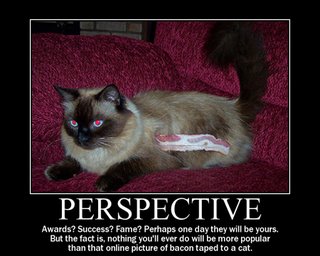
Scalzi Bacons the Cat and Gets the Attention He Deserves


I’ve been very amused as I’ve followed the recent events over at John Scalzi’s blog, and I get to write a blog entry where the title uses bacon as a verb – excellent!

Anyway, if don’t read Scalzi’s blog, called Whatever, he posts pretty much every day on a wide variety of issues, often with a fair amount of humor. On Wednesday, he was in procrastination mode and he posted a to-do list that included taping bacon to the cat. So, he did get to that and he taped bacon to his cat. Then the story got picked up by Fark (comments here) and his normally very high readership became astronomical. This morning we learn that Ghlaghghee (the abused cat) has a blog all her own and relates her side of the story. This morning Scalzi tries to find out if he is indeed the first person to post a picture of a cat and bacon on the internet. Oh, and you can find the motivational poster here.

Anyway – very amusing and I felt I had to share. And for those who don’t know who John Scalzi is, he won this year’s John C. Campbell Award and is the author of Old Man’s War, The Ghost Brigade and a few other books.

LinkWithin

Related Posts Plugin for WordPress, Blogger...