Showing posts with label horror. Show all posts

Wednesday, March 20, 2013

Review: The Folly of the World by Jesse Bullington

For some reason I still manage to be surprised when the book I’m reading tends to fit in with whatever conversation is currently going on in the SFF-intranets world. The conversation of the moment is all about grimdark, the term that seems to have emerged to describe the ‘gritty’ fantasy that maybe even could be called its own sub-genre (here are a few links to get you started on the discussion). But, I’m not going to quibble about the definition of grimdark, how appropriate it is attach the label to author X or Y’s books, or any of that. But, the book I am here to discuss – The Folly of the World by Jesse Bullington (Indiebound, Book Depository, Amazon) – arguably falls right in with the new kid dressed all in black at the back of the genre party who is buy angrily staring down everyone while (s)he trims his/her fingernails with a large knife.
 
The Folly of the World was wholly unexpected for me – I had heard good things about Bullington’s writing, but really didn’t know anything about it when I started the book (I hadn’t even read the back cover). So, it took me quite a while to figure out how felt about the book – honestly it took until after I finished reading it. The first thing that literally slaps the reader in the face is the very coarse language of the book, particularly in the first half. In the context of the book, it works, though it is above and beyond the coarseness of 99% of the books in fantasy. The dialogue is harsh, ugly and offensive. The descriptions are dark, evocative and unpleasant. And there are graphic descriptions of sex – man on man sex – that is needfully violent rather than sensual and loving.
 
After adjusting to the ruthless writing style I began to wander just where this novel was going. First, it’s not epic fantasy or even second world fantasy. It’s really much more historical fiction, or gothic horror (if gothic horror can apply to a setting in medieval Holland), with only the barest hints of the supernatural. In fact, I have no idea if there really is any supernatural element in the novel – and it doesn’t matter. The hints serve to increase the horror, set the mood, and relentlessly drive home the inevitable and hopeless end – or at least the perception of an inevitable and hopeless end.
 
Throughout this review I’ve used words like ruthless, horror, relentless, hopeless, harsh, coarse, dark, and …grimdark. The world is violent. There is death. There are battles. Horrible things are said and done. One could choose to describe things as tragic, and they wouldn’t be wrong, though I think folly is the better choice as the title itself clearly alludes to. The story shown, the actions and thoughts undertaken are often far too absurd to be anything but folly. The story at its heart is about a bastard seeking his noble birthright. Or perhaps it’s two highwaymen working a con to become noble. Or maybe it’s a rags to riches story. As expected, things don’t go as planned, but one of those cons does become noble, a peasant is lifted to the heights of society, and the fall from the edge is precipitous.
 
The view that Bullington chooses to tell his story through is important. The two conmen I mention above are front and center, though the real story is that of a peasant girl who is literally bought and paid for to help them recover a lost object. These three make up a motley trio representing the worst of the worst in society and genre alike. The two men are homosexual lovers, one is a bastard and the other is severely mentally ill. Both are killers. One will do and say anything to achieve his goals while the other is madly unpredictable. The girl is an uneducated peasant sold into service. She is harsh, violent, and a survivor. Horrible things happen – yet the girl is never raped and remains ‘pure’ through to the very end. It’s all gritty, dark and grim. There are very real conflicts, there is betrayal and death. Characters are wounded and they rise and fall from tragic archetypes to simple folly, though the usual, the obvious, doesn’t happen. There is much that can be said to all this – Bullington’s writing is layered with thematic depth and historical context. And frankly, I didn’t get it (at least not all of it). I typically consider that a good thing as it shows the book has deeper context and meaning than can be easily gained. And for that context, I recommend reading Indrapramit Das’s review over at Strange Horizons, it goes farther and deeper than I could ever hope to.
 
So far this review has meandered, only hinted at plot and character, and gained and lost momentum. In this, it mirrors The Folly of the World. The Folly of the World starts out fast, slows in the middle, only to pick up pace again toward the end. In all honesty, I almost did not finish this book. I kept waiting to see where the book was going, when that twist would occur. One twist occurred, and the second I kept waiting for felt like it never happened. Yes there were events and happens of importance to the story, but not at the level I was expecting (or hoping for?). With less than a hundred pages until the end I put the book down and seriously questioned whether I should bother continuing. I wish I could say that I felt that I had to know the end, but really I only continued because I felt that I had put in a lot of time already and just a bit more to finish it off made sense. I simply didn’t care – the title indicates that it’s the folly of the World, perhaps indicating a story of great significance to the world itself. It’s not. In fact it’s barely even significant in the dusty forgotten historical context it’s presented in. It’s only significant to the actual characters of the book.
 
Upon reflection I think this fits with the book. The book is folly, it’s the folly of humanity. It’s about unexpected love and dedication. It shows that what is important and significant varies greatly by perspective. It’s a book that the reader must love to hate and hate to love. It’s a book that works best when one can’t decide if it should be finished or not. That’s the folly of the book as well as the story within.
 
Did I enjoy The Folly of the World? That’s an answer I’m still searching for, but overall I think I can only say marginally. Do I appreciate The Folly of the World? Yes, Yes, YES. What Bullington does in this book is masterful, especially in the context of the conversation occurring in genre right now around grimdark, what it is and what, if any, value it brings. It’s a harsh truth, it’s a lot of harsh truths, it’s folly, it’s no easy journey to take, and not everyone will finish it. This only increases the ultimate value, if not necessarily its overall appeal.

Friday, October 14, 2011

Review: The Edinburgh Dead by Brian Ruckley

The Edinburgh Dead by Brian Ruckley (Book Depository, Powell's Books, Indiebound) is a significant departure from the epic fantasy trilogy that brought Ruckley to the attention of fantasy fans. Set in 1828 Edinburgh, a historic detective tale morphs into something darker and more sinister as Ruckley brings 19th Century Edinburgh alive in his best work to date.

Adam Quire is a war-hardened veteran and an officer for the newly-formed Edinburgh police. A particularly gruesome death doesn’t add up and Quire’s investigation leads him into puzzling and dangerous ground that points to the pillars of Edinburgh society. And then it gets personal and Quire releases the talent he keeps at bay – a talent for survival and extreme violence.

The Edinburgh Dead is the first book by Ruckley that I’ve read since his debut Winterbirth (Book Depository, Powell's Books, Indiebound). I found Winterbirth to be on the mediocre side and haven’t been inspired to finish the trilogy (though I do plan to eventually). In The Edinburgh Dead I immediately noticed that Ruckley’s writing has improved significantly. His descriptions are powerful and set the mood well – early 19th Century Edinburgh comes alive through his words. We see the intellectual powerhouse that Edinburgh has become – we also see the dark underpinnings that props up that distinction. There is privilege and there is everyone else. Lives are hard and dangerous – and there is the ever present need for more bodies to dissect on the cities medical stages.

The Edinburgh Dead is a true blend of many genres into one coherent and very well told story. It’s historic fiction, it’s a hardboiled mystery bordering on noir, it’s gothic horror, and it’s an urban fantasy supernatural thriller. Often when such cross-over happens, one still dominates or the combination doesn’t quite fit as well as it should – with The Edinburgh Dead it’s seamless – a natural blend.

The real strength of The Edinburgh Dead is the setting and the way in which Ruckley draws the reader into the dark and dangerous streets of Old Town. Edinburgh comes to life through the broken, beaten and resourceful Quire, a sinister life beneath the glamour of enlightenment. The relatively slow and steady pace continually builds towards the end – a perfect balance that resists the urge to rush. The only real fault is that Ruckley at time over-indulges with his descriptions, particularly in the latter half of the book where the mood has already been set.

The Edinburgh Dead is told mostly from the point of view of Quire and his personality dominates the book. This both good and bad – Quire is a powerful personality and vividly reflective of Ruckley’s 19th Century Edinburgh, however there are a few minor characters who could have been brought out more. If the book had been told entirely from Quire’s point of view, this flaw would have been less noticeable, but increasingly as the novel moves forward we see bits and pieces from other points of view to fill in the blanks of the evolving mystery.

All in all The Edinburgh Dead was refreshing change of pace from Ruckley and a very good historical gothic mystery horror urban supernatural thriller. I hope that Ruckley continues in this direction with more surprises to come.

Friday, September 05, 2008

Review:
The Man on the Ceiling by Steve Rasnic Tem & Melanie Tem

The Man on the Ceiling (US, UK, Canada) is the re-imagined and expanded version of the novella of the same name that won the Bram Stoker Award, International Horror Guild Award, and the World Fantasy Award, the only work to ever win all three. With such a pedigree I’ve been looking forward to this one for a while, only to find disappointment as the unexpected lingering reaction.

This loose mosaic tells the near-autobiographical story of the Tem’s family, at times sad, tragic, and heart-wrenching, yet always hopeful. The madness in their method brings forth an often horrific life to the text – these tag-teamed stories cross back and forth from a world of magical realism to surreal, playing with reality to reveal the truth.

As shown in The Man on the Ceiling, the Tem’s lead an extraordinary life – they adopt troubled and abused children, raising and loving them as their own. The exploration of their past, and their lives with their children and all the fears of life lies at the heart of this mosaic. A year ago I would have reacted very differently to this book, but now I have entered the world of parenthood. Part of the Tem’s journey that is shared deals with the death of a child. In the past I would have found this appropriately tragic, but not having children, I would not have had a true connection and relation to such a tragedy. As a parent nothing causes more dread than the even the thought of a child dying, much less my own. It’s this aspect of the book that affected me most.

In many books the reader can’t help but wonder home much is taken from an author’s own life. The Man on the Ceiling repeatedly emphasizes that ‘everything we tell you is true’. With this statement a line is crossed, the world of fiction blends into the intimate lives of the authors. So assured of the autobiographical elements, I eventually found myself questioning that very ascertain of truth – have the Tem’s turned a common reaction upside down?

Literary – the word comes with baggage in the genre world, yet literary describes The Man on the Ceiling well. Through the exploration of the Tem’s lives universal fears and conditions are revealed strait out of the American heartland. Plot is fluid, unfocused, even nonexistent. Reality twists, turns, and climbs on the ceiling to reveal truth. Such an exploration won’t appeal to all – in fact, it didn’t exactly appeal to me. As powerful as the Tem’s story is, it feels as if it pulls up short, not going the full length it could and should have. I expected a powerful affect on me that would linger for days and even weeks after finishing the book – not only is this affect absent, but the book is already fading away to obscurity. Combined with this not being my usual reading fare and the lack of that final, expected punch, I’m left with luke-warm (at best) feelings for the book. 6/10

Thursday, June 26, 2008

Review: Already Dead by Charlie Huston

Charlie Huston's Already Dead (US, UK, Canada) takes the prototypical hard-boiled, noir detective template and injects it into a world of vampires. The result is not the Buffy-inspired urban fantasy romp that dominates the fantasy market these days, but a true noir detective tale that happens to star a vampire struggling for independence in clan dominated underworld.

Joe Pitt is fed up with the warring vampire clans and their hierarchy of rule. He ekes out an existence as a rogue living in one clan’s territory (The Society) while performing the odd job for various clients, including the dominant rival clan (The Coalition) of mid-town Manhattan. Clan tyranny and politics make it difficult on an independent in the secret underworld of vampires and Pitt walks a fine line playing the various factions off one another as he struggles to survive.

After an encounter with a trio of squatters infected with a flesh-eating strain of bacteria (aka zombies), Pitt ends up in unpleasant encounters with the leaders of both the Coalition and Society. As a result he is left with a new job through the Coalition – to find the missing daughter of a rich and powerful woman. Relatively standard progression occurs as Pitt investigates with an escalation in complexity and danger that sweeps him away, revealing the man behind the vampire and the sometimes moralistic rage encompassing both.

Huston’s world offers clever and adequate explanations for the how and why behind vampirism other supernatural phenomenon. Vampires are infected with an unknown to science virus colloquial known as the vyrus. It feeds upon human blood and gives the infected superhuman qualities that enable them to become superior hunters. The vampires of Huston’s world laugh at, subvert, utilize, and manipulate pop-culture’s embracing of vampires. Zombies result from an infection of flesh-eating bacteria that animates its dying host with hormones to keep it searching for other food sources (i.e. victims to infect). Brains are craved due to their high content of valuable hormones used to keep the host viable.

Huston envisions the dark side of Manhattan most choose to look past while creating the perfect sense of antagonistic paranoia. This world of the dispossessed, criminals, and others exists and thrives beyond the law with the vampire clans even further beneath this underworld. Here the clans both supplement and replace the organized crime networks common to the noir world where the rich and powerful, human and vampire alike, use and abuse this world to their own ends.

The best part of Already Dead is Joe Pitt – a classic anti-hero, noir detective-who-is-not-actually-a-detective. Pitt’s history brings an extra dimension of depth often missing – a childhood of horrible abuse, an adolescence and young-adulthood of abusing, a role as enforcer within a vampire clan, and finally, a rejection of it all and the attainment of a some-what flawed moral high ground and sense of justice. Much of this comes about in his introspective thoughts surrounding his girlfriend, Evie – a young HIV-infected bartender. She refuses to risk infecting Pitt, and Pitt struggles with the knowledge that his vampirism, unknown to Evie, could cure her HIV with curse of his affliction.

This classic noir story with zombies, vampires, pornography, evil corporate moguls, clan warfare, and a hard-ass, flawed, moralistic rogue vampire proves to be a fast-paced, engaging read that I very much enjoyed. I eagerly anticipate the further adventures of Joe Pitt in No Dominion (US, UK, Canada), Half the Blood of Brooklyn (US, UK, Canada), and forthcoming Every Last Drop (US, UK, Canada). 8/10

Monday, December 24, 2007

Review: Firefly Rain by Richard Dansky

Firefly Rain by Richard Dansky launches the new Wizards of the Coast Discoveries imprint featuring original speculative fiction works that cover a wide range of subjects. I stepped outside of my typical reading habits for this one – Firefly Rain is more horror-suspense and southern-gothic (or snowbird gothic as Dansky himself describes it) than the typical SFF I read. In many ways this is an enjoyable step back in time for me since I read a lot more within the horror genre (mostly Stephen King and Dean Koontz) when I was younger.

Jacob Logan is returning home and the vacant house and empty land deep in the Carolina countryside are the last place he wants to be. His last visit was to bury his mother along side his father and he hopes this visit will be equally brief. Jacob immediately notices a few oddities as his luck turns even worse – things just don’t feel right. Encounters with Carl, the particularly surly groundskeeper and equally surly local cops only add to his worries has he struggles with the ghosts of his past.

Firefly Rain takes two of the more common horror tropes – estranged relations with family and the creepy small town – and writes a really decent story with them (well, there’s a third common trope but I’ll leave that out here). It reads fast and the descriptive prose captures the dark and threatening mood of the story well while interjecting just the right amount of humor at the right times. Dansky really shines in his portrayal of the small southern town with friendly hospitality laced with a distrust of outsiders and a sharp word for superior-minded city-folk.

Told in a first-person point of view, a lot of time is spent getting into the mind of Jacob. As a result, Jacob’s character is presented well, though it left me wanting more. The estranged relationship with his parents lies at the heart of things, but we are never given very convincing reasons why. I suppose it could be viewed positively that Dansky didn’t feel the need to go over the top and throw all sorts of horrifying abuses at Jacob’s childhood, but I did find myself questioning why things seemed so bad to Jacob.

With the concentration on Jacob, the supporting cast is regulated to little more than caricatures that manage to serve their roles well. In an all-too predictable way, every person we are introduced to has an eventual role to play. It could be considered efficiency, but it rubbed me a bit wrong in the ‘everybody really is out to get me’ kind of way.

The plot moves forward adequately, with the best parts of the book coming in the more descriptive aspects. At times you could feel the oppressive wet heat of the south and the lightening-quick change of weather that a storm can bring. It had me remembering the ominous feeling you can get when visiting that distant relative in the country and their creepy old house – where my city car gets stuck on the road or a flat tire in the mud.

Firefly Rain was a quick and refreshing change of pace from my usual fair. I enjoyed it quite a bit in spite a couple flaws and have no trouble recommending it to most any audience. It’s a decent debut for Wizards of the Coast Discoveries and I look forward to seeing what comes next. 7/10

Sunday, February 04, 2007

The Scent of Shadows by Vicki Pettersson

I’ll be honest – I didn’t have very high expectations when I started this novel. This book fits squarely into that sub-genre residing between horror and fantasy, with a touch of erotica, starring vampires, werewolves, and other baddies with an ass-kicking femme fatale with a dark past and problems in her love life getting thrown into a truly shocking and horrifying situation. These books just aren’t my thing – often too cliché, predictable, and gratuitous for my taste. So, it was very pleasant surprise that I enjoyed this book.

The Scent of Shadows is not a vampire book or a book about any monster we’ve read about before. Pettersson takes her time to introduce something new – basically a supernatural race of good guys and bad guys fighting it out behind the scenes of us mere mortals. We don’t have pantheon of gods and monsters – just a bunch of super-humans battling in the age old good versus evil struggle, and what better place for this battle than Las Vegas. Fans of Vegas will enjoy this new side of Sin City from an insider’s point of view.

Joanna Archer is the definition of a disturbed, independent woman with a number of issues to work out. Subconsciously searching for the man that raped and left her for dead when she was a child, Joanna has become removed from family and friends, having only her camera and martial arts as support. Let’s cut to it – bad things happen and in the process she learns that she is more than human – she is a born superhero that has been long hidden from both the good guys and the bad guys. The good guys are in danger of loosing it all and Joanna is the key to their survival or elimination.

In a bit of strange effort, Pettersson has attempted to combine this good versus evil struggle with comics. The activities of the Zodiac Troup 175 (yes, that really is what they are called) are mirrored in comic books – two sets, one for the shadow and one for the light (and you can’t read the opposing team’s comics). This sets up one of the more amusing and scenes in the book where our beautiful femme fatale squares off against a bunch of comic store geeks. The problem is that this aspect of the story was half developed at best – it needed to be fully fleshed out or left out altogether. As written it amounts to basically nothing but filler.

Yes, this book is as clichéd as it sounds. It’s predictable too. The writing is inconsistent – the first sentence of the book alone was almost enough to make me stop reading. The thing is that in spite of all that, I couldn’t put the book down. Pettersson sets the mood and grips you, not letting go. I wanted to know what happened next – I needed to know. Joanna turns out to be a fascinating character, and even with what little we see of others, they have a bit of depth as well.

The Scent of Shadows is a book that can’t be put down, and I really enjoyed reading it. However, with the shortcomings mentioned above, and a few not mentioned, it only partially succeeds. Fans of Kim Harrison and Laurell K. Hamilton will likely not only not notice, but absolutely love this book. For me, it gets 6.5 out of 10. I really wanted to rate it much lower, but I can’t deny that I enjoyed it and literally couldn’t put it down. As I said initially, it was a pleasant surprise.

Of course a book like this is literally made for sequels. While it stands well on its own, much is left unresolved for future adventures. The Taste of Night will be this continuation, being released shortly after The Scent of Shadows.

Monday, March 06, 2006


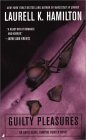
Guilty Pleasures by Laurell K. Hamilton

Vampires! I’ll admit, like many people out there, I do enjoy a good vampire book from time to time. Guilty Pleasures is Hamilton’s first installment in a series of books starring Anita Blake, Vampire Slayer. The books are decently popular, so I decided to give it a read.

Imagine the world we exist in, however, vampires, lycanthropes (from werewolves to wererats), zombies, ghouls, etc. are very real creatures. Vampires in the US have a bad rap, but they are gaining some civil rights – it’s now illegal to ‘murder’ a vampire. The city of St. Louis has uneasily embraced its undead inhabitants, making them a major tourist attraction – visit a vampire strip club or the circus of the damned or join the vampire church – no abstract concepts of immortality here, join and you can ‘live’ forever.

Anita Blake is an animator – someone who has the power to raise the dead. She is also a vampire hunter, contracted by the police to kill ‘problem’ vampires. In an ironic twist, Anita, the ‘executioner’, has been hired by both the police and the city's most powerful master vampire to find who has been killing some of the city’s most powerful vampires.

Anita is both strong and vulnerable, and one hell of a cynic. Vampires are soulless, powerful creatures, and Anita would love to see the world free of them. Not only is she working for vampires under the threat of the death and dismemberment of a friend (and herself), but someone is trying to kill her; things have been better. She is uneasy, scared, and angry. And when she’s angry, even a thousand-year old master vampire should take notice.

Guilty Pleasures is a quick, fun read. While it is certainly an ‘R-rated’ book, it is not the sex-filled book many seem to imply about Hamilton’s books (of course, I haven’t read any of her others). The atmosphere is dark, dirty, and a bit perverted, but Hamilton balances this well Blake’s cold wit and sarcasm, though it can be forced at times. The writing suffers from the typical awkwardness of a first book, but not so much that it can’t be overlooked.

On my 10-point rating scale, where 5 is a take-it or leave-it book, and 10 is unsurpassed, Guilty Pleasures rates a 6 to 6.5. I enjoyed this book, and will read the next installment of Anita Blake, Vampire Slayer: The Laughing Corpse. Guilty Pleasures is not a book of great depth, just a fun, quick, horrific romp through a world of monsters helmed by the darkly funny Anita Blake.

LinkWithin

Related Posts Plugin for WordPress, Blogger...