Monday, February 28, 2011

Review: The Wise Man’s Fear by Patrick Rothfuss

After years of anxious waiting, The Wise Man’s Fear by Patrick Rothfuss (Book Depository, Powell’s Books, Indiebound) is one of this year’s most anticipated epic fantasy books. Following up on the hugely popular (though not universally so) debut, The Name of the Wind (Book Depository, Powell’s Books, Indiebound), fans and critics alike are wondering if The Wise Man’s Fear lives up to its predecessor. In my opinion it does – it features the same wondrous story-telling, entertaining style and shows improvement in Rothfuss’ craft. Translation: if you liked The Name of the Wind, you can bet that you’ll like The Wise Man’s Fear – probably even more.

The Wise Man’s Fear picks up on day two of an older Kvothe’s narration of his life, his coming of age and into legend, to the Chronicler. The story begins shortly after the events of The Name of the Wind and carries things forward. We follow Kvothe as he continues his studies at the University, takes time off to see the world, attempts to gain a patron, learns to fight, gets in over his head, and eventually returns to the University. For those like me who haven’t read The Name of the Wind since its release in 2007, a re-read could be beneficial, but I was just fine without one.

In this series, Rothfuss sets out deconstruct the standard epic fantasy hero. To do this he must embrace a number of the classic tropes involved – Kvothe is orphaned, driven to avenge his parents’ death, attractive, arrogant, gifted (at music and in some academic pursuits), an adolescent coming of age, a legendary fighter, a talented wizard, etc. The joy for me is in watching Rothfuss slowly dissect this ideal fantasy hero – a classic Gary Stu if you will. Rothfuss chooses to do so by having an older and (possibly) wiser hero relay his story to a chronicler and the reader sees this all through the first person perspective of Kvothe telling his coming of age story. Kvothe chooses what to share and how to share it while periodic interludes provide hints of the popular versions of these events as told by people at large and offer other fun and interesting perspectives. Kvothe often leaves out what would otherwise seem rather important – like the time he is on a ship attacked and sunk by pirates which he barely survives after which he spends time as a penniless beggar is glossed over in only a couple of lines, yet he spends pages mooning over the girl of his dreams. Apparently one of the more infamous events in Kvothe’s popular lore is a trial that he eventually wins – yet he barely mentions it in his retelling, much to the chronicler’s chagrin. The reader is left wondering which is more at work – the exaggeration of rumor or Kvothe’s own version of things?

It’s in this style with Kvothe as a narrator that is both one of Rothfuss’ greatest strengths and weaknesses. The reader sees that the infamous Kvothe Kingkiller is at times nothing more than bumbling idiot of an adolescent – utterly clueless about events around him and women in particular. We get to see Kvothe learn to fight in a distant land where he gets his butt kicked repeatedly (often by little girls) and never even becomes an average fighter among those that teach him. And at other times we see nothing but arrogance. Kvothe tells the stories he wants – so we get to see him talk endlessly about his lady love. We get to hear all about those stories from the University – you know the types that your buddy tells over and over even though you’ve heard them all 1000 times before. The events that you feel are important are either lacking or different. And it’s all complicated by the factor that Kvothe is probably not the most reliable narrator – did he ever grow beyond that arrogant kid who loved to embellish stories about himself?

Through it all, the journey is in the story and the story is in the journey. Rothfuss’ books aren’t set up with the awe-inspiring climatic events of the standard epic fantasy. The main events in the book are internal to Kvothe – what means most to him. The rejection of his lady-love is a much more important event to him than slaughtering a gang of murderous imposters and rescuing a couple of village girls – while both impact him greatly, one haunts him in a much more profound way even though he himself thinks it should be otherwise. Rothfuss reinforces his emphasis on the journey by utilizing stories-within-stories-within-stories.

The truth is that all of this would be a complete failure if not for Rothfuss’ incredible story-telling ability. The style that he writes with is intoxicating and addictive – there is energy to his story-telling that cannot be denied. Calling the book a page-turner doesn’t quite do it – this is a 1000+ page book that reads like a book less than half its size. In a time when I have very limited time for reading, I still managed to finish it in less than a week. The way Rothfuss writes makes me think he’s one of those people that you could spend all night listening to as they tell one ridiculous story after another. At the time of your listening you are having the time of your life, later in retrospect you kind of wonder what the big deal was.

So, in my mind The Wise Man’s Fear absolutely lives up to and even surpasses Rothfuss’ entertaining debut, The Name of the Wind. However, I think it’s also equally clear that The Wise Man’s Fear has essentially the same strengths and weaknesses as The Name of the Wind. Like me, many fans will get lost in Rothfuss’ superb story-telling, while others will be let down by a book that begins and ends at the University and once again lacks the standard climatic ending of a typical epic fantasy book. A book that still offers no hints about the king-killing of the trilogy title of The Kingkiller Chronicle and no resolution to plots set in motion in book 1. For me the value is in the journey – the story – and with Rothfuss telling, I’m all ears. 8-8.5/10


Related Posts: Review of The Name of the Wind (note, this is an early review in the first couple of years of the blog – I like to think I’m a bit better at it now)

Thursday, February 17, 2011

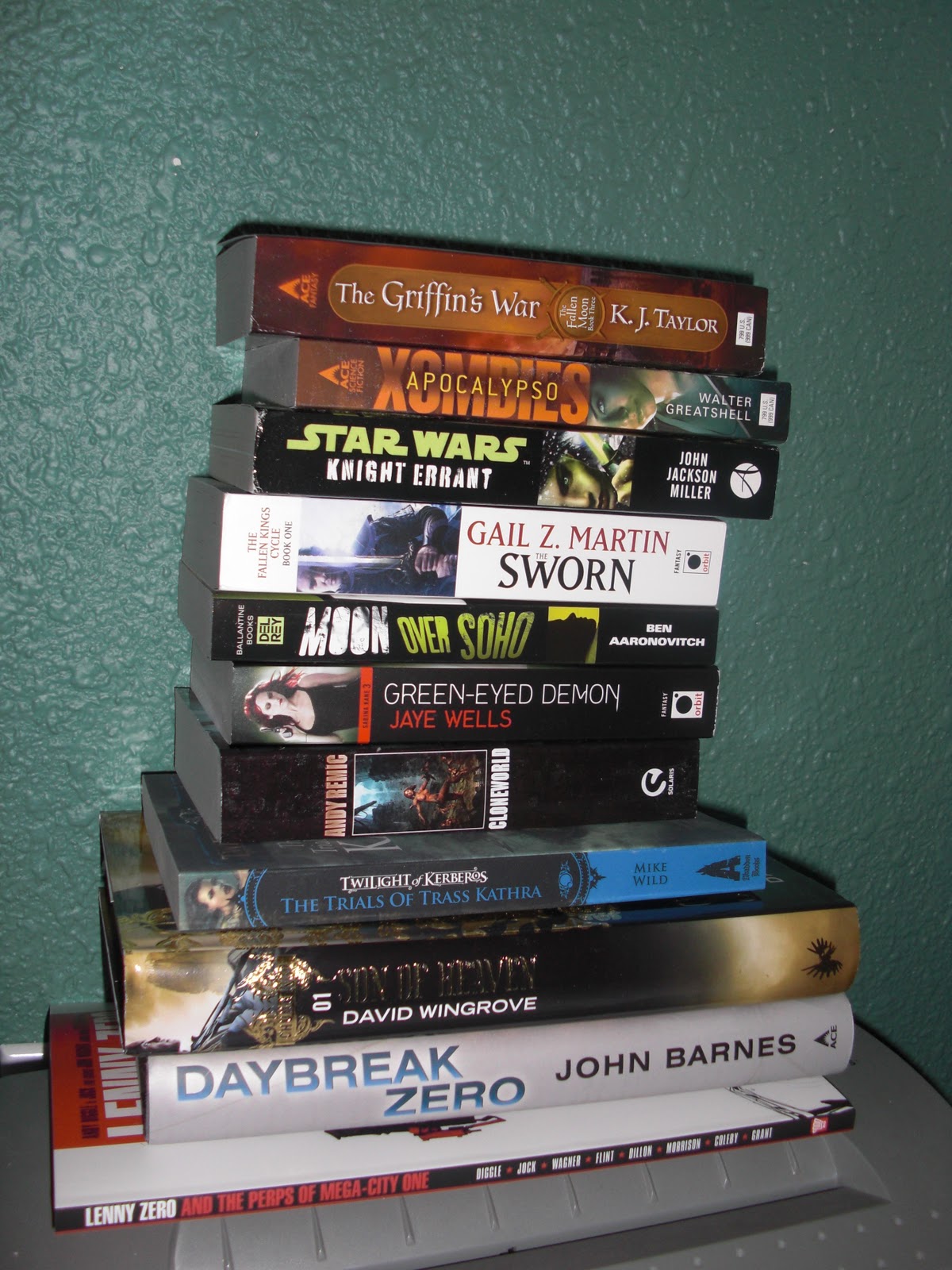
Books Received: February 9 - 17

Books received: February 9-17, 2011.

Updates and Info

Struggles in my personal life both continue and continue to improve. But I’m still not even back to full time with work, so if I don’t have time for work, I certainly am not left with much time for something like blogging. I still manage an hour or two a day with reading (sometimes longer if I let my daughter sleep on me during the day), so I’m reading quite a bit, I’m just not finding the time to write up my reviews. They will come, just slowly. Below is a list of books I’ve finished but not yet reviewed (except The Crippled God which I’m about half-way through).

Forthcoming reviews (when I can get to them):

·         The Dark Griffin by K.J. Taylor (Book Depository, Powell’s Books, Indiebound)
·         The Fallen Blade by Jon Courtenay Grimwood (Book Depository, Powell’s Books, Indiebound)
·         The Wise Man’s Fear by Patrick Rothfuss (Book Depository, Powell’s Books, Indiebound)
·         Never Knew Another by J.M. McDermott (Book Depository, Powell’s Books, Indiebound)
·         Midnight Riot by Ben Aaronovitch (Book Depository, Powell’s Books, Indiebound)
·         The Crippled God by Steven Erikson (Book Depository, Powell’s Books, Indiebound)

The state of those reviews ranges from nothing to detailed notes to (really) rough drafts. Even though I list them in the order that I finished (with The Dark Griffin finished back in early January) I doubt reviews will come in that order. I expect I’ll publish a review for Wise Man’s Fear on the day it’s released – March 1st. The Crippled God will also get priority once finished. Never Knew Another is a bit closer to publishable review than others so it could show up as soon as early next week. We’ll see.

And because I don’t want this post to all about me, below are a few links that may be of interest.

A few links of potential interest:

·         Here are the details to Steven Erikson’s upcoming UK tour. Unfortunately there are no plans for a US tour any time soon (maybe someone should start up a campaign to get him over here). Also, Erikson has posted up a few series-ending notes of appreciation for his fans – awww shucks…that was nice of him.

·         So, the blogosphere got it’s panties in a bunch when some nut-job conservative said a bunch of stupid and ill-informed things about the modern state of the fantasy genre – pointing fingers at some its most popular authors. Reactions have been swift and varied, sometimes quite reasonable and informed, sometimes they are even more crazy than the original post, and some try to set themselves above it all. And various author-types keep showing up in the comments – especially in Abercrombie’s reaction. For me – apathy.

·         A mass coronal eruption could affect technology – or at least result in cool aurora visible pretty far from the poles.

Monday, February 07, 2011

The Perilous Offence: It Smelt of Americanization

Or what colour is a football?

I’m just finishing up Midnight Riot by Ben Aaronovitch (Book Depository, Powell’s Books, Indiebound) and I can’t help but be annoyed at the apparent level of Americanization that occurs in this book. For a background, Midnight Riot is set in London and features a rookie cop who is thrown into some rather interesting events that may or may not involve magic (okay, they do involve magic, but that’s not the issue). Throughout what has been a largely enjoyable read, I keep getting yanked out of the flow of the story by what appears to be the American cleansing of a British novel (did you spot the pun?).

For example, the main protagonist mentions his love of soccer several times during the book and discusses it once or twice. Really? Someone raised in a rougher part of London likes soccer? I’m pretty certain it’s called football ‘round those parts. Even the title was scrubbed a bit – Midnight Riot is published as Rivers of London in the UK. Now, a there could be a whole separate debate on which title is more appropriate – each is both somewhat appropriate and rather out of place based on the content of the book, but Midnight Riot seems to me to be much more generic. As a reader, a book called Rivers of London peaks my curiosity, but Midnight Riot – no interest there. If it weren’t for some positive buzz I’ve seen elsewhere from trusted sources, I’d have let this book fly right by.

I can except that when a book crosses the pond that Queen’s English spelling gets shifted to American English. That’s fine – after all, I read American English. But I think it takes things too far when the colloquialisms of language become effected. I want to feel the atmosphere of a book, and when a born-and-raised Londoner speaks of soccer all sorts of flags go off, destroying that carefully crafted atmosphere. Most books I read that originated in the UK don’t scrub so thoroughly, so that’s probably why this one stands out so much.

Why? Does Del Rey see this one having such mass appeal that they need to dumb it down? Is it even necessary to dumb down a British book for the masses of the US? I think a tremendous disservice was done to the readers here, and to the author as well who put so much work into creating an atmosphere that feels like the streets of London.

So, good readers, what do you think of all this?

Friday, February 04, 2011

Review: The Heroes by Joe Abercrombie

In a few short years Joe Abercrombie has risen to be one of the hottest young authors writing in fantasy today, and deservedly so. In The First Law Trilogy Abercrombie takes on the standard epic fantasy trilogy – only he turns it upside down, inside out, slits its throat and yells FU. In Best Served Cold (Book Depository, Powell’s Books, Indiebound) he writes the fantasy version of a revenge novel, only bloodier, darker and more disturbing. In his latest novel, The Heroes (Book Depository, Powell’s Books, Indiebound), Abercrombie attacks the war novel while he slowly hangs, draws and quarters a traditional idea of heroism.

The Heroes focuses in a way that few fantasy novels do – essentially, the novel takes place over only three days at a single battlefield. The back and forth seizure of high ground, the taking and re-taking of key river crossings, cavalry charges, ambushes and all that abound. Yet as typical with Abercrombie’s writing, the way that the characters themselves view it says it all. From the young recruit eager to gain a name and become a heroic legend like his father to the wizened old soldier who wants nothing more to get away from it all to the ambitious daughter of a general seeking to increase the influence of her dishonored husband, to the cowardly plotting once prince of the North to the disgraced former guard of the King, Abercrombie shows the horror, futility, irony, and viscera of war.

In other reviews of Abercrombie’s books, I’ve worried about him becoming something of a one-trick pony – sure he may do the one trick really well, but it can be tiresome. Especially when the trick is overwhelming darkness and a total lack of redemption in characters. With The Heroes, I’m happy to see that Abercrombie shows what I’ve always suspected – that he isn’t a one-trick pony, that he skewers one-trick ponies and slowly roasts them. One of the first thoughts I had while reading The Heroes is that it’s good writing, not the standard good storytelling of fantasy writing, but real talent at work where just a few words provide multiple meanings and depth. Now I’m not saying that Abercrombie has become a literary stylist or anything, just that he’s honed his craft and improved his skill as a writer with every book he’s published.

Subversion is one of the favorite catch words in fantasy these days – right behind gritty. Both words find themselves use routinely in reviews of Abercrombie’s work and deservedly so. Forget gritty – for an Abercrombie book it’s kind of like saying the sky is blue. But subversion – this is where Abercrombie’s writing really sets him apart. A key component of so much of the fantasy genre is heroism. And it may be this very key component that makes fantasy so appealing to read – after all, Western society loves the hero. Forgetting entertainment (which could go on forever), think of how quick society is to label someone a hero – be it a war hero, someone who rescues a baby from a burning home, a child battling cancer, etc. Hell, our society is so fascinated by heroes that it came up with the idea of superheroes. In The Heroes, Abercrombie uses a classic war novel in a fantasy setting to explore the idea of heroism. As one would expect, Abercrombie takes a deeply cynical and ironic view of heroism, but never a simplistic one.

One of the issues I have with Best Served Cold is that it is too dark, too cynical, and simply over does the lack of redemption in revenge. The characters were well done, just not likeable enough to truly enjoy the book. In The Heroes Abercrombie rediscovers that balance between levity and cynicism that made The First Law so much fun while it depressingly dismantles the ideal of epic fantasy. The Heroes is dark, it’s gory, it’s futile, yet it’s entertaining – a near-impossible balance to achieve, yet so important for success in a genre dominated by escapist reading.

The Heroes is a mostly stand-alone novel set in the same world as Abercrombie’s other novels. The story is self-contained, yet many of the characters and the background conflict between Bayaz and the Prophet are dealt with in his other books. So, even though the story is stand-alone and could work as an introduction his fiction, a reader does benefit from having read Abercrombie’s other works.

Abercrombie continues to show growth and improvement as an author and The Heroes is stellar example of why he has become so popular in a relatively short time. The Heroes showcases the strengths of Abercrombie’s writing – characterization, dark ironic wit, and not-so-subtle subversion of traditional fantasy ideas. And Abercrombie is never afraid to get dirty, really dirty. 9/10


Thursday, February 03, 2011

Room With a View: San Antonio

I was in San Antonio last weekend for a wedding - so, a new room with a view post.

5 Years

On February 3, 2006 I officially started this blog. At that point there weren’t that many SFF blogger-review sites and I really didn’t have any plans or ambitions. I just thought it might be a convenient way to store a few reviews instead of letting them get lost in forum archives. Imagine my shock when I discovered that people were actually reading those reviews – people from all over the world – a couple of who turned out to be editors and authors.

I should probably have some grand post that cleverly shows all the wild happenings on this blog that have ranged from asking an author in an interview about a book he didn’t write (thank you cut and paste) to an author making an idiot of herself responding to my review here and elsewhere (and a whole lot in between). I should have a list of my favorite books of these past 5 years and perhaps even my least favorite. But time is short and after 5 years I can be a bit of crotchety old blogger. I could have a great post with statistical analyses of my review scores, but I’ve done that before and I image I’ll do it again – so not here. I should have a summary of the most popular posts and a snarky discussion of some the crazy search phrases that have led people here. But, remember I’m crotchety in my old age. Below are a few general facts that don’t mean all that much.

·         180 reviews
·         ~600 blog posts
·         ~50 interviews
·         A few hundred followers through RSS, Twitter, Facebook, etc.
·         A few hundred thousand visits (exact number unknown due to RSS feeds)
·         Over 700 books received from publishers

So, it’s been a great 5 years. I’ve made a number of friends among other bloggers and fans and even perhaps a few authors. I’ve met a number of authors in person and a lot more through the internet. And I’ve read a few good books. So, hopefully the next 5 years will be as fun as the previous.

Cheers!

Tuesday, February 01, 2011

Mini-Review: Antiphon by Ken Scholes

Antiphon by Ken Scholes is the third book in The Psalms of Isaak series (Book Depository, Powell’s Books, Indiebound) – a planned series of five. In Antiphon things really take off, which means I can’t say too much about it without completely spoiling events in the first two books – which would really be a shame with the way Scholes slowly reveals answers only to leave more questions in their place. Combined with my rather hectic life of late, I’ve decided to keep my review rather short and sweet. This really is a rather good series and something with a bit of different flavor than the usual fair, so I suggest checking my reviews of Lamentation (Book Depository, Powell’s Books, Indiebound) and Canticle (Book Depository, Powell’s Books, Indiebound).
In Antiphon Scholes continues with his strategy of slowly revealing mysteries and takes it step further by revealing other truths behind mysteries previously revealed as the series continues forward. What you think you know is probably wrong, and with Antiphon probably wildly so. The science fiction flavor to the fantasy of The Psalms of Isaak really comes out in surprising form at the same time that fantasy aspects wrench it up another level. Through this Scholes shows us both what is great and not-so-great about genre as he expands the possibilities of his writing and lets it get away from him in the end.
Frankly, while Antiphon is good, it was a bit of a let-down in quality following Canticle. However I can say that after the events in Antiphon, I have no idea where Scholes is going to go with things, but I’m sure it’s going to be extraordinary. 7.5


Saturday, January 29, 2011

Best of 2010

2010 was another busy year here at Neth Space. The real world has kept me from reading as much as I’d like – but that’s nothing new, just a bit extreme as I dealt with the things ranging from the divorce of my parent to the birth of my second child and a few medical challenges thrown in. I did manage to read 30 books in 2010. A few interesting stats are summed up below.

Stats:

  • 30 books read
  • 24 Published in 2010
  • 3 Published in 2009
  • 3 Published earlier (2007, 1976 and 1969)
  • 1 was YA (down from 5 in 2009)
  • 20 are part of a series
  • 25 were provided by the publisher
  • I read more books published by Random House (7) and its various imprints than any other – 2 from Del Rey, 2 from Ballantine, 2 from Spectra, and 1 from Pantheon (I suppose you could bounce it up to a total with 8 if you count 1 book from Transworld on the other side of the pond). The next closest were Tor (6), Pyr (4) and Orbit with 3.
  • 3 books were published by ‘small press’ (down from 5 last year)
  • 2 are short story collections (same as last year)
  • 8 are written by female authors (up from 3 last year) and 5 were written by a person of color or other distinct ethnicity from my own (possibly more since this is a difficult thing to keep track of)
  • 6 are what I consider science fiction (up from 4 in 2009)
  • 10 are what I consider epic fantasy (down from 18)
  • Only 1 is what I consider steampunk (down from 3)
  • 8 are what I consider urban fantasy (up from 5)
  • 4 are what I consider sword and sorcery
  • Only  is what I consider alternative history/historical fantasy
  • I conducted 7 Interviews and helped out with a couple of others
  • There have been approximately 57,000 site visits this year (not counting RSS) from 139 countries. Roughly 45% from the USA, 12% from the UK, and 9% from Canada.
  • The Westeros Forums and Pat’s Fantasy Hotlist are the top referring sites (other than Google).
  • My review of Towers of Midnight by Robert Jordan and Brandon Sanderson was the most popular post by far. The next most popular post was my review of The Way of Kings by Brandon Sanderson, so this year seems to have been the year of Brandon. Third place by less than 100 views went to my review of The Passage by Justin Cronin. I find 4th place very interesting since it is my review of The First Law Trilogy by Joe Abercrombie – a series that has been out for a while now and a review that is several years old. This tells me that Joe has a strong staying power (or that my Google-fu for that post is particularly good).
.
So, the best books I read this year are listed below. It’s not a top 10 list and it’s not presented in any particular order – though my ratings of the books generally get higher as you move down the list – with Who Fears Death as the clear top book of 2010.


Kraken by China Miéville (Book Depository, Powell’s Books, Indiebound)

Kraken is the latest from the highly decorated China Miéville and a return to London. It’s a story of religious, cultist and criminal fanatics, it’s the story of a young man awakening to world around him, it’s a story of loss, it’s an apocalyptic, action-packed thriller, it’s magical, it’s squidpunk, it’s all a bad joke…and it’s simply an example of a master at work. Highly recommended. (full review)


The Way of Kings is Sanderson’s most recent original work and the first book in a planned massive series. It’s his best book to date and the start of something very promising. The world is wonderfully creative with a deep history and uncertain future, the characters draw you in and make you care, and it all combines into something very special. Sanderson’s name may have leaped into the spotlight on the coattails of The Wheel of Time (though he was certainly on his way up already), but The Way of Kings proves that he belongs. This is a book that all fans of epic fantasy need to read and it could serve a great introduction for new fans to the genre, both young and not-so-young, as long as they can get past intimidation of 1000+ page book. My final thought can only be this: Brandon, when do we get book 2, because I want it now! (full review)


So, does The Left Hand of Darkness stand up 40+ years later – emphatically, YES! This novel has a timeless feel about it and a wonderful subtly wrapped in important thoughts that are inherent to our society and species. We will always be a gendered society, but just what do these gender roles mean? And the dichotomies within can apply where they weren’t necessarily aimed – the Cold War of the planet Winter now reads much more like an interesting take on the differences between Democrats and Republicans in the US – and I’m sure that those from other places will find their own modern analogs if they wish. This book earns its write to be at or near the top of any ‘best of’ list and easily belongs in a series of Masterworks. (full review)


So, the buzz surrounding The Passage is already huge and I see it only growing. It’s a genre book from a literary writer with potential appeal to a much wider audience than either alone. For us genre readers, a vampire apocalypse novel may not seem like it should be the next great book, but as always, it’s all about the execution – and Cronin executes The Passage with near-perfection. This book earns the buzz, this book should be read and discussed widely, this book is both literary and genre, this is a book I highly recommend. (full review)


So Sleepless is an apocalyptic crime story plus many other pieces that all add up to literary fiction. Yes, this is a book that is both genre and literary (in spite of having a plot). It is very much a discussion on the human condition – it’s just that most of the human conditions viewed are what so many of us would choose to deny exist. This is both a book that I can’t recommend highly enough and a book that I don’t think I ever want to read again. It is excellence, it is depressing as hell, and thankfully, it’s not entirely without hope. (full review)


Erikson has written something I think all authors dream of writing at one point or another but are either too scared or too smart to actually put on paper. Well, as a fan, a critic, and a far from noble knight, I have to say that I loved every juicy bit of Crack'd Pot Trail – I think I’ve developed a taste for it. (full review)


As I keep getting at, Who Fears Death is a lot of things, but most importantly, it’s a beautifully written book in a setting can only be considered unique in the world of fantasy. Okorafor’s writing magically reveals the story, effortlessly endearing characters to the reader, and engineering a story that simply must be read. The African feel of Who Fears Death may be what sets it apart from its contemporaries, and it may be the reason many choose to read or pass it by, but the timeless, human story within is the real reason to pick it up.

The bottom line is that Who Fears Death is the chance that readers should take. It celebrates the true diversity of SFF literature and reveals the struggles of a part of the world often overlooked. It’s a timeless, human tale that I highly recommend. (full review)

Honorable Mentions

Of course there are quite a few very good books that didn’t quite crack the uppermost tie – the 5 below just missed the cut. But really, I only read 1 or 2 books that I wouldn’t recommend for one reason or another.


And for kicks – the worst book I read in 2010


While The Chamber of Ten is a bit of a breath of fresh air in the world of urban fantasy – there’s not a werewolf or vampire in sight – it suffers under the generic feel of feeling like a Dan Brown imitation. The prose is a bit better that Dan Brown, but the storytelling is not. I think traditional SFF fans won’t find it terribly interesting and traditional thriller fans won’t buy into the speculative aspects of the story. This seems to leave The Chamber of Ten without an audience. (full review)

LinkWithin

Related Posts Plugin for WordPress, Blogger...